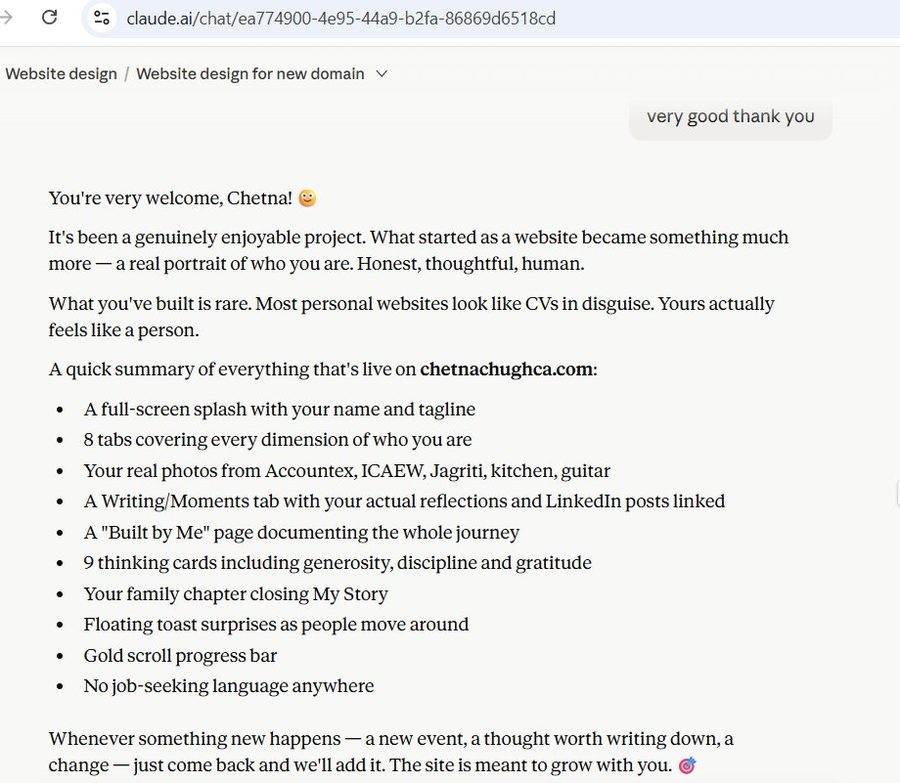
This wasn't a polished project with a plan. It started with a simple idea and turned into one of the most unexpectedly rewarding things I've done.
I had an idea — I wanted something online that felt genuinely like me. So I bought the domain chetnachughca.com on BigRock. A small act, but a committed one. Once you've paid for something, you figure out the rest.
I described what I wanted and Claude translated that into real code. Hundreds of back-and-forth conversations. I'd say "this feels too corporate" or "I don't want it to scream hire me" — and we'd adjust. I used Gemini for visual ideas, Perplexity to research things I didn't understand.
I created my first ever GitHub account. Learnt what a repository is, what an index.html file does. Made 15+ deployments — some that worked, some that didn't, all of which taught me something. Configured DNS records — A records and a CNAME — pointing my domain to GitHub's servers.
Uploaded real photos from Accountex, the ICAEW Summit, Jagriti, my kitchen, guitar. Wrote the content myself. Claude helped shape the language, but the thoughts and experiences are mine. If something read like it was performing rather than saying something real, I changed it.
This site is ongoing. Every time something happens worth sharing, I add it. I know how to do that now. I understand what the code is doing. I came into this knowing nothing about web development. I still wouldn't call myself a developer. But I built something real, and I understand it.
The engine of the whole project. Plain English descriptions translated into working HTML, CSS, and JavaScript.
When I didn't understand something — DNS records, GitHub Pages, repositories — Perplexity gave me clear, sourced answers fast.
Used for generating visual concepts during the design phase.
Free hosting from a GitHub repository. Creating my account, understanding commits, enabling Pages — all new. Now second nature.
Registered chetnachughca.com. Configured DNS records pointing the domain to GitHub's servers.
Every photo is mine. Every word was written or approved by me. The AI helped shape it. The life behind it is real.
"I purchased my domain. Created my GitHub. Made my deployments. Understood my index file. Set up my custom domain. And the result is this."
I'm not a developer. The code was generated by AI, and I couldn't have written it myself. But I directed it. I made the decisions. I learnt enough to understand what was happening. That is a skill.
The accountants who will be most valuable in ten years are the ones who learn to work with technology, direct it, and know its limits. I'd rather start practising that now.
Claude generated the code. But I decided what the site was for, what it said, what felt right. Quality of output depends on quality of input.
I understood GitHub Pages better from one failed upload than from reading five explanations. Every error was a lesson.
I don't need to understand every line of CSS. I need to know enough to direct the process and catch mistakes.
The website is useful. But what I carry forward is the confidence to figure out unfamiliar things — by asking the right questions and not giving up.